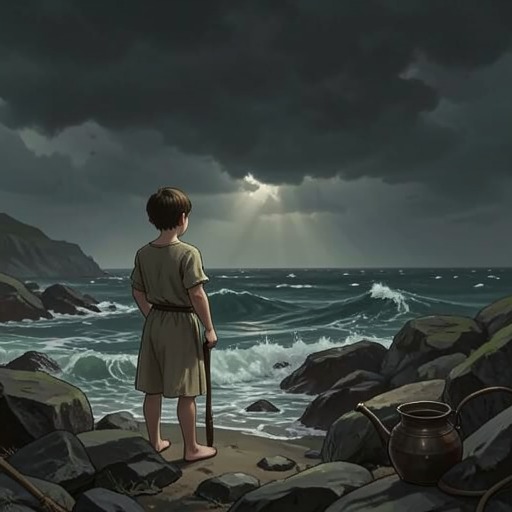
Shasta reports the attack to King Lune and rides to Anvard
The Horse and His BoyShasta reports the attack to King Lune and rides to Anvard at the decisive point when a desperate escape becomes a warning that can organize a defense. Sent onward by the Hermit of the Southern March, he reaches King Lune’s hunting party and reports that Rabadash and two hundred horsemen are approaching; Lune trusts the boy’s firsthand account and sets out at once. The episode makes Shasta’s endurance and credibility consequential: the warning is not simply delivered, but accepted in time to direct the response.
The warning becomes Shasta’s next task
The report follows an already punishing journey. At the Hermit’s enclosure, Shasta learns that Aravis is wounded, the horses are spent, and Rabadash is finding a ford over the Winding Arrow. The Hermit identifies the danger to King Lune and tells Shasta to go straight ahead, through whatever terrain lies in his way, without stopping. Shasta has little strength left and feels the demand to be unfair, but he asks where the king is rather than refusing the task. The Hermit points him toward the opposite gate and insists that he run.
That direction makes the episode a continuation of Shasta’s escape rather than a separate undertaking. He leaves the enclosure alone while the Hermit remains with Aravis and the horses. The immediate objective is specific: reach King Lune before Rabadash can advance farther, and warn him of the force coming toward Anvard.
The run and the encounter with King Lune
Shasta runs through grass and heather toward trees, with shaking limbs, a stitch in his side, and sweat obscuring his sight. His attention narrows to the movement demanded of him; he has no plan to make beyond continuing forward. The contrast between his depleted condition and the urgency of the message gives the run its force: he must carry information that others can act upon, although he arrives with almost no strength to spare.
A horn sounds, and Shasta emerges into a glade where he finds a hunting party of roughly fifteen or twenty gentlemen in green hunting dress, with their horses. King Lune is among them, about to mount. Shasta first asks whether the king is King Lune, then immediately gives the warning: Rabadash is coming with two hundred horsemen, and Anvard’s gates must be shut. The essential message is compressed into a few urgent instructions, with no attempt to disguise how close the threat is.
Firsthand testimony and immediate response
One of the gentlemen, Darrin, asks whether Shasta is certain. Shasta answers that he has seen the enemy himself and raced them all the way from Tashbaan. When Darrin questions whether he made the journey on foot, Shasta explains that he travelled with the Hermit’s horses. His report is thus grounded in direct observation, while his account of the route also explains how he reached the hunting party.
King Lune stops further questioning. He says that he sees truth in Shasta’s face, calls the warning sufficient, and orders the gentlemen to ride. A spare horse is brought for the boy, and Lune asks whether he can ride fast. Shasta mounts promptly, his ease in the saddle reflecting the practice he has gained during the journey with Bree. Darrin remarks on his seat and suggests that noble blood may account for it, but the immediate practical consequence is clear: Shasta can join the king’s party as it moves to respond.
Significance in the larger crisis
The scene brings together two kinds of evidence: the Hermit’s knowledge that Rabadash is crossing the Winding Arrow, and Shasta’s own sight of the approaching force. The Hermit supplies the direction and urgency; Shasta carries the warning to the person who can act. King Lune’s decision to trust him turns a solitary runner into part of the kingdom’s response to the attack.
The action also marks a shift in Shasta’s role. His earlier escape has depended on companions and on finding a way through danger; here, the Hermit entrusts him with a task whose value lies in reaching someone else in time. Shasta does not arrive rested or fully informed about what will follow. He arrives with what he has seen, states it plainly, and is believed. The ride that begins after the report connects his exhausting journey to the defense of Anvard.